
2 September 2026 · Mark Stent
How Many Days a Week Should You Train? A Straight Answer for Lifters
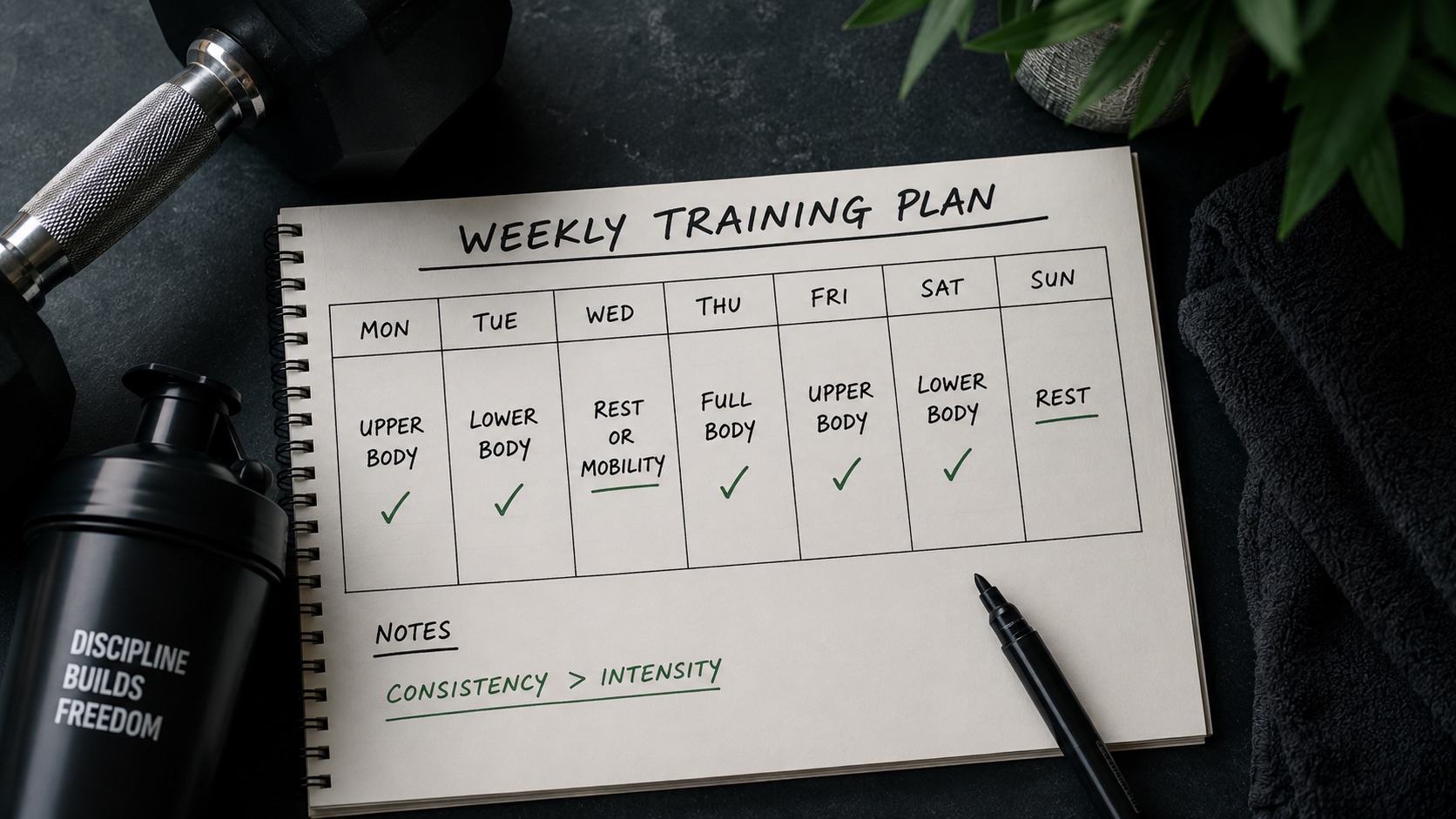
Most people should train three to five days a week. Three days is enough to build real strength and muscle, four is the sweet spot for most lifters with jobs and lives, and five or six is for those whose recovery and schedule can genuinely support it. Two days a week still works and beats not training. The best number is the one you can hit consistently in a normal week, not a perfect one.
What matters is not days - it is weekly volume
Here is the thing most articles miss: your muscles do not count days, they count hard sets per week. Aim for roughly 10 to 20 hard sets per muscle group per week (the productive range) and it barely matters whether you spread that across three days or six. More days just means fewer sets per session and more recovery between them.
So the real question is not "how many days is best" in the abstract. It is "how many days lets me hit my weekly volume while actually recovering and actually showing up." Everything below flows from that.
How many days a week: what each gives you
| Days per week | What it gets you | Best-fit split |
|---|---|---|
| 2 | Solid maintenance and real beginner progress; hard to add much volume | Full body |
| 3 | Enough to build strength and size properly; great for beginners | Full body or 5x5 |
| 4 | The sweet spot - each muscle twice a week, good recovery | Upper / lower |
| 5 | High volume without a full six-day grind | Upper/lower + an extra day, or PPL |
| 6 | Maximum frequency and volume; needs real recovery capacity | Push / pull / legs |
Notice the split changes with the days. That is the whole game: pick your realistic days first, then pick the split that fits, which is exactly the order in how to build a workout routine.
Can you build muscle training only 2 or 3 days?
Yes - clearly. On two or three days a full-body routine still hits each muscle two or three times a week, which is plenty of frequency to grow. A beginner training three hard full-body days a week, eating and sleeping enough, and adding weight over time will build strength and size for months. You do not need to live in the gym. You need enough hard sets, real effort, and progressive overload.
If two or three days is your honest ceiling, do not feel short-changed. Just choose a split that keeps frequency high rather than one that trains each muscle once a week.
Is training 6 days a week too much?
Not automatically - but it is the schedule most likely to backfire. Six days only pays off if you can recover from it: enough sleep, enough food, and sensible per-session volume. Pile on six days of high volume without the recovery to match and you accumulate fatigue faster than you adapt, and progress stalls despite all the effort.
More days is a tool for fitting in more volume, not a badge. If you are hitting your weekly sets and progressing on four days, a fifth and sixth day add fatigue, not results. Add days when you need somewhere to put more productive volume, not to prove something.
Do you need rest days?
Yes. Muscles grow during recovery, not during the session, and your joints and nervous system need it too. Even on a six-day plan, take at least one full rest day. On three or four days, the built-in gaps handle it. Rest days are not lost progress - they are when the progress actually happens.
If you feel beaten up, run down, or your numbers are sliding week over week, that is usually under-recovery, not a bad program. The fix is often a day off and more food and sleep, not another session.
So how many days should you train?
Walk it back to front:
- How many days can you hit in a normal, busy week? Be honest - count the bad weeks, not the ideal ones.
- Match a split to that number using the table above.
- Hit your weekly hard sets across those days.
- Progress and recover. Add a little over time; sleep and eat enough to back it up.
Three or four days, done consistently for months, beats a six-day plan you abandon by week three every single time.
How Setkord helps you stay consistent
Consistency is the whole ball game, and it is easier when the plan runs itself:
- Save your split as routines (or start from the built-in program library) so every session is ready in a tap - no deciding what to do at the gym door.
- Your last weight and reps pre-fill, making progressive overload obvious week to week.
- Personal records and your estimated 1RM are tracked automatically, so you can actually see whether your current number of days is working.
- It works fully offline and the core is free forever.
You show up; Setkord keeps the score.
FAQ
How many days a week should I train to build muscle? Three to five for most people. As long as you hit around 10 to 20 hard sets per muscle per week and recover, the exact number matters less than doing it consistently. Two days still builds muscle, especially for beginners.
Is 3 days a week enough to build muscle? Yes. Three hard full-body sessions a week hit each muscle three times and easily reach a productive weekly volume. Plenty of strong, muscular people never train more than three days.
Is training every day bad? Training seven days a week with no rest is a bad idea - recovery is when you actually adapt. If you train most days, keep per-session volume in check and take at least one full rest day. More frequency only helps if you can recover from it.
How many rest days do I need per week? At least one, and often two or three depending on your split and how you recover. If your numbers are sliding or you feel run down, add a rest day and check your sleep and food before blaming the program.