
2 September 2026 · Mark Stent
Training Volume for Muscle Growth: The Complete Guide to Sets, Reps, and Weekly Load
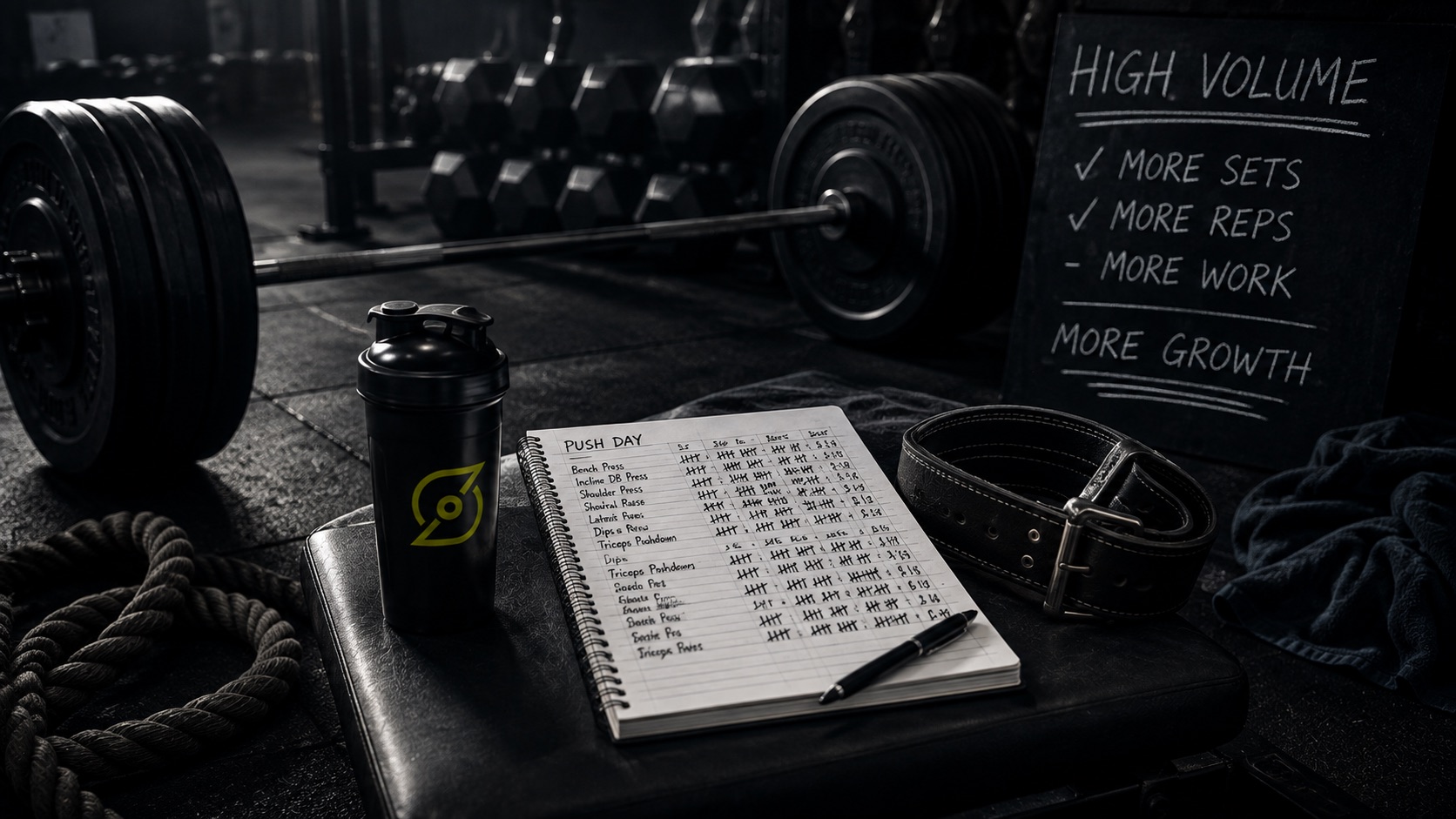
Training volume is the total amount of hard work you do for a muscle, and it is the single biggest lever for muscle growth once your effort and technique are in place. In practice, volume is measured as the number of hard sets you do for a muscle per week, and most lifters grow well on somewhere between 10 and 20 sets per muscle per week. Do too little and you leave gains on the table; do too much and recovery, not muscle, becomes the bottleneck.
What is training volume?
Training volume is how much work you do for a muscle over a given period, usually a week. You will see it defined three ways, and it helps to know which is which:
- Hard sets per muscle per week - the count of working sets taken close to failure. This is the version most coaches and most of the research use now, because it is simple and it tracks growth well.
- Volume load (tonnage) - sets x reps x weight. Useful for tracking a single lift over time, but a clumsy way to compare a heavy triple to a set of 15.
- Reps in the effective range - total stimulating reps. More precise in theory, fiddly in practice.
For building muscle, count hard sets per muscle per week. It is the number that matters and the one you can actually plan around. If you want the deeper version of that count, read how many sets per week to build muscle.
Why volume drives muscle growth
Muscle grows in response to mechanical tension applied through a challenging range of motion, repeated often enough to force adaptation. A single hard set gives you a dose of that stimulus. More hard sets, up to a point, give you more.
The research lands on a fairly consistent picture: within a sensible range, more weekly sets produce more growth, with diminishing returns as the sets pile up. It is a dose-response curve that flattens, not a straight line you can ride forever. That flattening is the whole reason "just do more" eventually stops working.
How much volume do you need?
Here is a practical starting framework by muscle per week:
| Weekly sets per muscle | What it does |
|---|---|
| Under 6 | Enough to maintain, rarely enough to grow much |
| 10 - 14 | A solid growth range for most lifters, most of the time |
| 15 - 20 | Higher end - works if your recovery, sleep, and food support it |
| 20+ | Advanced, and easy to overshoot into junk volume |
Start at the lower end of the growth range, around 10 sets, and add from there only when progress stalls. The mistake is starting at 20 sets because "more is better" and having nowhere to go when you plateau. Volume is a resource you spend over months, not something to max out in week one.
These landmarks have proper names - MEV, MAV, and MRV - and knowing them makes progression far less of a guess. Read MEV, MAV, and MRV volume landmarks for the full breakdown.
Not all sets count the same
This is where most volume calculations go wrong: people count every set they did, not every set that actually stimulated the muscle. A set taken nowhere near failure, with sloppy form or a half range of motion, is close to worthless. Counting it inflates your volume number and hides why you are not growing.
A set only counts as volume if it was a genuine working set - a challenging load, a full range of motion, and stopped within a few reps of failure. Everything else is junk volume, and it costs you recovery without buying you growth. This distinction matters enough that it gets its own guide: what counts as a working set.
How to add volume without breaking down
More volume only helps if you can recover from it. The way to add it safely is slowly and deliberately:
- Add a set or two per muscle per week, not five. Small jumps let you find the amount that works instead of overshooting it.
- Add volume where you are lagging, trim it where you are not. Balance beats raw totals.
- Watch your recovery, not just your logbook. Persistent soreness, stalled lifts, and dread before training are signs you have passed useful volume. See the signs of too much training volume.
- Volume is only half of progression. The other half is load and reps climbing over time - progressive overload. Volume gives the muscle something to do; overload makes sure it keeps getting harder.
If you spread your sets sensibly across the week and across muscles, you get more usable volume for the same effort. Sets per muscle group per week covers how to split it up.
How to track training volume in Setkord
You cannot manage volume you are not counting, and counting hard sets per muscle across a week in your head is a losing game. Setkord does it for you:
- Every logged set is tagged to a muscle group, so your weekly sets per muscle add up automatically - no spreadsheet.
- Muscle-balance stats show you at a glance where you are over- and under-training, which is usually the real reason a body part lags.
- Insights (Pro) charts your volume trends over weeks and months, so you can see whether you are genuinely adding volume or just moving it around.
- It is local-first and works fully offline, so your logging is instant in any gym with no signal, and your last weights and reps pre-fill on every set so you always know the next jump.
You decide how hard to train; Setkord keeps the count honest.
FAQ
Is more volume always better for muscle growth? No. Growth improves with more volume up to a point, then flattens and eventually reverses as recovery becomes the limit. The goal is enough volume to grow, not the most volume you can survive.
How many sets per muscle per week should a beginner do? Start around 10 hard sets per muscle per week. It is enough to grow, easy to recover from, and leaves room to add more once you plateau.
Does volume matter more than how heavy I lift? They work together. Load and effort make each set count; volume is how many of those sets you accumulate. A pile of easy sets and a single all-out set are both incomplete - you need hard sets, and enough of them.
How do I know if I am doing too much volume? Watch recovery, not just the logbook: stalled or dropping lifts, soreness that never clears, poor sleep, and low motivation are the usual signs. See signs of too much training volume.